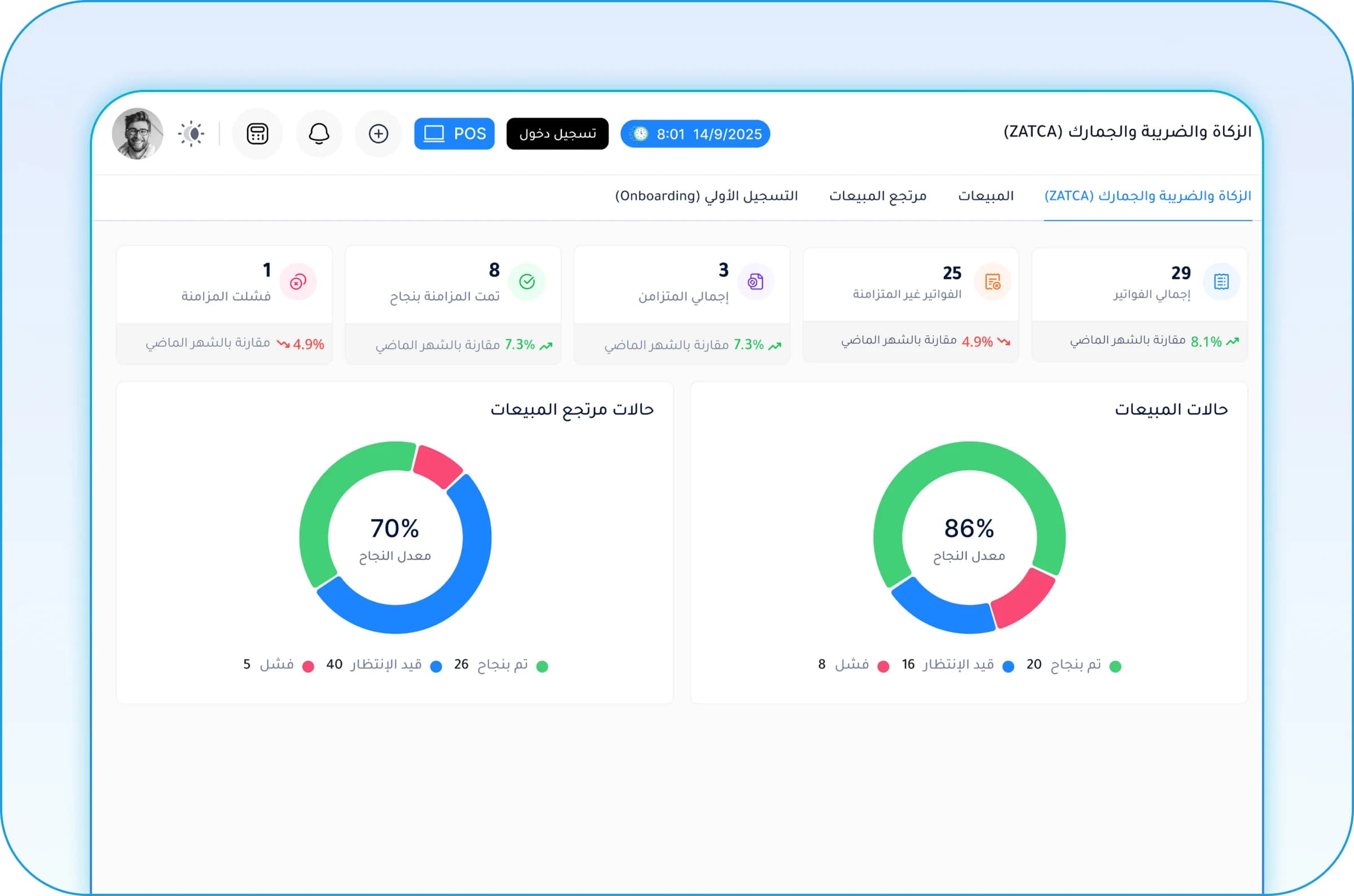
E-invoicing is mandatory for every VAT-registered business in Saudi Arabia. The Zakat, Tax and Customs Authority (ZATCA) applies it in two phases: the Generation phase (since 4 December 2021), which requires invoices to be issued from a compliant electronic system, and the Integration phase (since 1 January 2023, in waves), which requires that system to connect to the FATOORA platform and send invoices to it.
What is an e-invoice in Saudi Arabia?
An e-invoice is issued, stored and amended in a structured electronic format through a system that meets ZATCA’s requirements. A scanned paper invoice or a PDF typed by hand is not an e-invoice in this sense.
The system aims to raise transparency, fight concealment and simplify tax compliance. It applies to every VAT-registered business and to anyone issuing invoices on its behalf.
The two phases: Generation, then Integration
| Item | Phase 1: Generation | Phase 2: Integration |
|---|---|---|
| Start date | 4 December 2021 | From 1 January 2023, in successive waves |
| Who | All VAT-registered businesses | Businesses notified by ZATCA based on revenue |
| Requirement | Issue and store invoices from a compliant electronic system | Connect the system to FATOORA and send invoices to it |
| Invoice format | Electronic, with a QR code on simplified invoices | XML, or PDF/A-3 with embedded XML |
| Extra elements | No untraceable edits or deletions | Cryptographic stamp, UUID, invoice hash chain |
ZATCA notifies each business of its Phase 2 date at least six months ahead. Watch the email registered with ZATCA and your account on its portal.
Standard tax invoice vs simplified tax invoice
| Standard tax invoice | Simplified tax invoice | |
|---|---|---|
| Used for | Business-to-business sales (B2B) | Sales to consumers (B2C) |
| In Phase 2 | Clearance: sent to the platform and cleared before it reaches the buyer | Reporting: sent to the platform within 24 hours of issue |
| QR code | Required in Phase 2 | Required since Phase 1 |
| Buyer details | Include the buyer’s VAT number | Usually optional |
The same rules apply to the credit and debit notes linked to each invoice type.
What is not allowed
- Handwritten invoices, or invoices made in Word or Excel.
- A system that lets an invoice be edited or deleted after issue without a trace; corrections are made with a credit or debit note.
- A system that allows tampering with date and time or issuing more than one sequence for the same invoice.
- In Phase 2: handing a standard tax invoice to the buyer before the platform clears it.
How to prepare for Phase 2: a practical checklist
- Check your business details on the ZATCA portal and the email where notices arrive.
- Review your current system: is it listed as compliant, and does it support FATOORA integration?
- List every point that issues invoices: branches, POS terminals, online store and field sales.
- Onboard each e-invoice generation solution (EGS) unit with the platform and obtain its cryptographic stamp certificate.
- Test invoices in the sandbox before your date, including credit and debit notes.
- Train accountants and cashiers on what changes, especially handling rejected invoices.
A common mistake is treating invoicing as a separate program. When invoicing is part of an ERP system, the invoice comes from the sale itself and flows to inventory and accounting with no double entry.
What to look for in an e-invoicing system
- Compliance with both phases and direct FATOORA integration.
- Customizable Arabic invoices with your logo and details.
- A link to POS, inventory and accounting, so the invoice is part of the sales cycle.
- Multi-branch support with many issuing points in one system.
- Ready VAT reports to make filing easier.
- Support that understands ZATCA’s requirements and follows its updates.
E-invoicing in Rabt
In Rabt by RSD, invoices are part of the sales cycle: they are issued from the POS or from sales and update inventory and accounting automatically. We provide customizable invoices with a QR code and ZATCA integration depending on implementation, and agree your business’s requirements with you before we start.
Frequently asked questions
Is e-invoicing mandatory for every business in Saudi Arabia?
Yes. The Generation phase has been mandatory for every VAT-registered business since 4 December 2021. The Integration phase rolls out in waves, and ZATCA notifies each business of its date in advance.
How do I know when my business joins Phase 2?
ZATCA notifies the business at least six months before its integration date, based on its taxable revenue.
Is a PDF sent by email enough as an e-invoice?
No. An e-invoice must be issued from a compliant system. In Phase 2 it is XML, or PDF/A-3 with embedded XML, with a cryptographic stamp and QR code.
What is the difference between clearance and reporting in Phase 2?
Clearance applies to standard B2B tax invoices: they are sent to the platform and cleared before reaching the buyer. Reporting applies to simplified B2C invoices: they are sent to the platform within 24 hours of issue.
Can an e-invoice be changed after it is issued?
No, it cannot be edited or deleted. Corrections are made by issuing a credit or debit note linked to the original invoice.