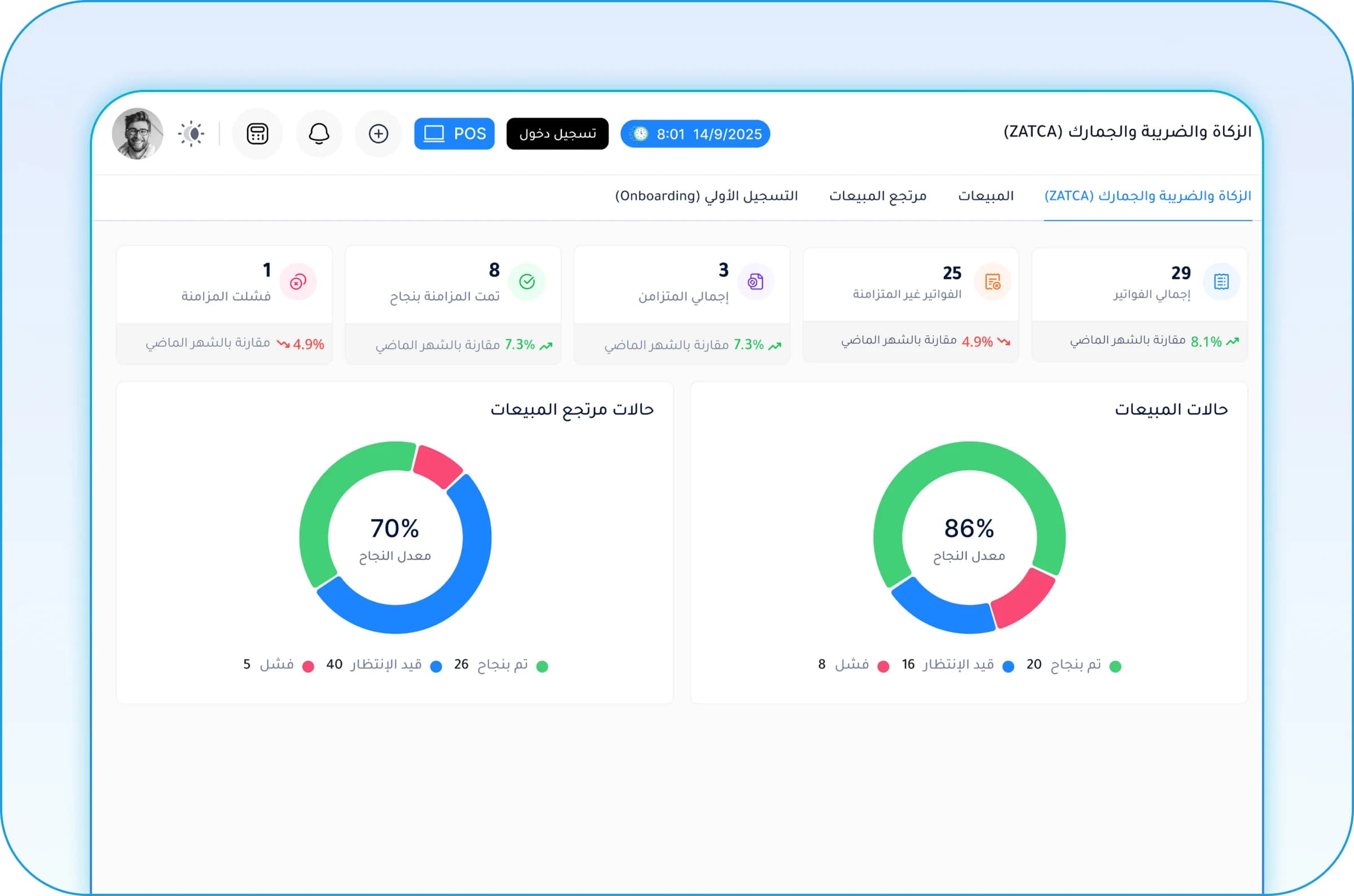
The Egyptian Tax Authority (ETA) runs two linked systems: the e-invoice for business-to-business (B2B) and government sales, and the e-receipt for sales to consumers (B2C). In both, the data of every sale is sent electronically to the ETA the moment it is issued, and the document gets a unique ID that can be verified.
E-invoice vs e-receipt
| E-invoice | E-receipt | |
|---|---|---|
| Type of sale | Business-to-business (B2B) and government (B2G) | To the end consumer (B2C) |
| Issued from | Sales or accounting system | Point of sale (cashier) |
| Submission | Real time through system integration | Real time from registered POS terminals |
| Signature and verification | Approved electronic signature on each invoice | QR code on the receipt for the consumer to verify |
| Examples | A supplier selling to a company, a factory selling to a distributor | Supermarket, restaurant, pharmacy, clothing store |
Many companies need both: for example, a distributor that sells to shops with e-invoices and runs a showroom selling to individuals with e-receipts.
Who has to comply?
The ETA began rolling out the e-invoice in phases in 2020, starting with large taxpayers and expanding to VAT-registered businesses. The e-receipt has been rolled out in phases since late 2022, with the ETA announcing which groups each phase covers.
Dates and groups are updated regularly. Check ETA notices and its official portal, or your chartered accountant, for your company’s exact position.
It also matters that costs not backed by e-invoices may not be accepted in a tax audit, so you want your suppliers to issue e-invoices, and to issue them to your own customers.
Technical requirements for e-invoices
- Register your company on the e-invoicing portal.
- Obtain an approved electronic signature (signing certificate or e-seal) from a licensed provider.
- Code your items and services: global GS1 codes or internal EGS codes registered on the system.
- Connect your system through the integration APIs to send invoices automatically, or enter them manually on the portal for very small volumes.
- Test submission in the pre-production environment before going live.
Manual entry on the portal only works for a very small number of invoices. With any real sales volume, direct integration from your system saves time and prevents copying errors.
What changes at the point of sale with the e-receipt?
- Register your POS terminals with the system and connect them.
- Send the data of each receipt to the ETA at the moment of sale.
- Print a QR code on the receipt for the consumer to verify.
- Keep selling during internet outages and send delayed receipts when the connection returns, as the system allows.
- Code your items, as with e-invoices.
Practical steps to prepare your company
- Decide whether you need the e-invoice, the e-receipt or both, based on who your customers are.
- Clean up item data — a clear name, unit and code for each item — before coding it on the system.
- Check business customers’ details: name, tax registration number and address.
- Choose a sales or ERP system that supports integration, so the invoice comes straight from the sale.
- Prepare the electronic signature and POS hardware.
- Train accountants and cashiers to handle rejected documents and how to correct them.
Why an ERP system helps
When sales, inventory and accounting live in one system, the invoice or receipt is issued from the sale itself, with item codes registered once, and flows to inventory and accounting entries without re-entry. Separate programs mean typing the same data twice — which is where errors and mismatches start.
Rabt by RSD connects sales and POS to inventory and accounting, with customizable invoices. Contact us to review the system’s requirements for your company and how to apply them.
Frequently asked questions
What is the difference between the e-invoice and the e-receipt in Egypt?
The e-invoice is used for sales between businesses and to government bodies; the e-receipt is used for sales to end consumers at the point of sale. Both are sent to the ETA when issued.
Do I need an electronic signature to issue e-invoices?
Yes. Every e-invoice is signed with an approved electronic signature from a licensed provider before it is sent to the system.
What is the difference between GS1 and EGS codes?
GS1 codes are global standard product codes; EGS codes are internal codes the company creates and registers on the system. Every item or service needs a code of one type.
Can e-invoices be issued manually on the portal?
Yes, for very small volumes. With any real sales volume, direct integration from your sales system is faster and has fewer errors.
How do I know whether my company must use the e-receipt now?
The ETA announces the groups covered in each phase and notifies taxpayers. Check its official portal or ask your chartered accountant.